
Cross-Generational Analysis of Empathy and ADHD
We know we are changing — and we prefer to think we are not getting worse, despite what this article and others like it might evoke. We are aware that we are writing this from inside the problem itself: analysing generational change requires distance, and distance requires time. Any observer old enough to have perspective is already, by definition, looking backwards. And looking backwards always carries a degree of longing.
In this article, we explore attention and comprehension through the lens of environmental ADHD — a concept that examines how our surroundings, rather than biology alone, shape our cognitive capacities.
We will also explore the concept of "empathy mutation": rather than concluding that empathy has diminished or worsened over time, we argue that it has transformed alongside us — in ways that are often perceived as artificial or shallow, but are no less real.
We will examine several generations through the lens of their ability to process and understand information — whether studying, reading the news, or following a conversation — and how the arrival of television, personal computers, the internet, and smartphones has reshaped the way we understand the world, relate to one another, and navigate challenges.
Baby Boomers (1946 – 1964) — The Rise of Advertising
By the mid-twentieth century, television had become the entertainment hub of the household. One screen per family, placed at the center of the living room as if it were one more member of the family. News programs, series, and game shows structured family life: dinner was served at a set time, silence was kept when the evening news began or when the father wanted to watch his sports program, and the children were given their cartoon slot. Television did not merely entertain — it set the rhythm, structured the day, and created the default shared experience across every home.
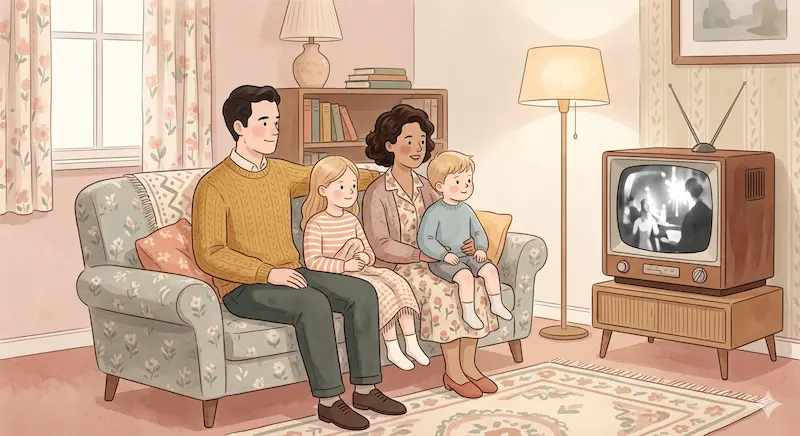
Yet its mass arrival triggered a cultural alarm. Intellectuals, educators, and parents pointed to it as an enemy of thought: it would dull children's minds, destroy the reading habit, and put an end to real family life. It was, according to its critics, the perfect machine for producing passive citizens — unable to question what they were shown. The model was one-directional: someone broadcast, millions received. That passivity quickly became a recurring debate about technology and cognition.
And yet, theatre did not die. Neither did cinema, nor books. What happened was far more interesting: each medium found its new place within the cultural ecosystem. The fear of culture's end proved, as it almost always does, greater than the actual damage. What nobody anticipated at the time is that this model of passive consumption might turn out to be only the first step.
The Boomer Generation: Proximity Empathy
Before this era, empathy was rooted in eye contact and physical community. Over time, this connection mutated into something more intangible and delocalized, yet far more global — allowing an individual to feel tied both to the members of their own household and to people separated by thousands of miles who would never meet.
Generación X (1965 – 1980)
Generation X grew up in the shadow of the television that had dominated their parents' childhood. Unlike them, however, these individuals were no longer willing to be passive spectators. The arrival of the personal computer and the pop culture of the 1980s offered them something new: the ability to interact, to choose, and to create. They learned to filter the noise of mass consumerism without abandoning it entirely, keeping one foot in the analogue world — books, vinyl records, conversations over a drink — and the other in the digital one that was just beginning to emerge.
Punk, grunge, alternative culture, and institutional skepticism were not generational coincidences — they were direct responses to a society that had sold the American dream through a screen and was beginning to show its cracks. Generation X was the first to openly question the model of life that television had normalised, doing so with irony, emotional distance, and a healthy distrust of anything that sounded too polished or too packaged.
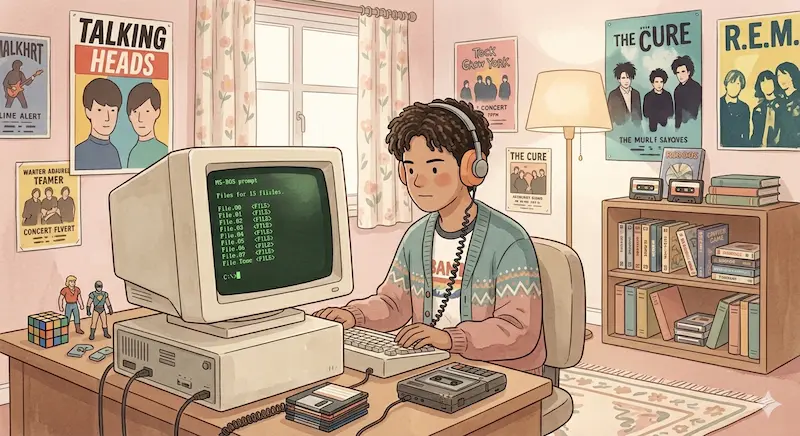
Generation X: Cynical / Critical Empathy
Thanks to pop culture and early globalisation, they began to empathise with distant realities — but always filtered through a layer of scepticism and emotional distance. They could feel solidarity with a cause on the other side of the world while simultaneously distrusting the institutions promoting it.
Millennials (1981 – 1996) — The Mobile Invasion
Millennials are the generation that experienced the deepest changes during childhood and adolescence. They went from playing in the street to playing online, with consoles as the bridge in between. From watching scheduled television to streaming on demand. From looking things up at the library to searching on Google. No other generation has straddled two such radically different worlds within a single lifetime.
The key turning point was the invasion of the smartphone and broadband internet. Millennials lived through the transition from "connecting to the internet" to always being connected — and that shift changed everything. It was here that attention began to fragment in earnest, driven by the pull of instant gratification: notifications, likes, and real-time updates rewired the reward system before anyone had time to notice.
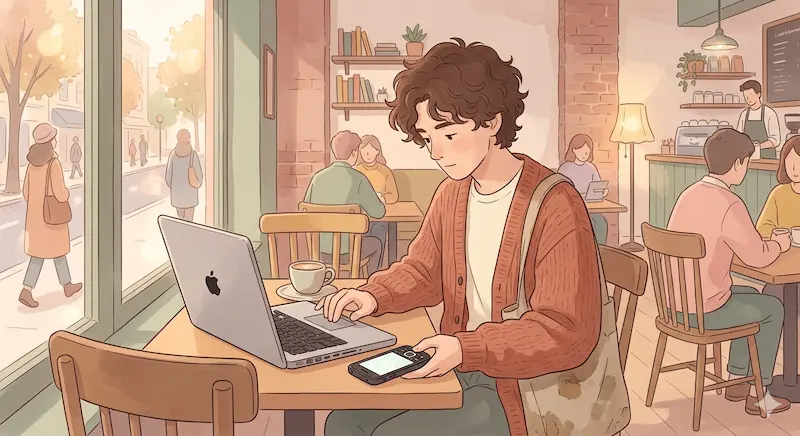
Millennials: Hyperconnected Empathy
The smartphone broke down barriers — but also introduced new ones. Millennials began to empathise more with the curated profile than with the actual person behind it. Emotion became performative: sharing a cause online felt equivalent to acting on it. This is the generation that gave birth to keyboard activism — genuine in intention, but often disconnected from real-world impact.
Centennials / Gen Z (1997 – 2012) — The Algorithm Generation
Gen Z are true digital natives — they never knew a world without the internet, and many barely remember one without a smartphone in their pocket. The defining force of their formative years was not a device but a system: the algorithm. Infinite scroll, personalised feeds, and short-form video built an environment engineered to capture and hold attention at all costs. Their capacity for synthesis is remarkable — able to extract meaning from a fifteen-second clip that would take others minutes to process — but that same environment made sustained, deep attention increasingly rare.
This is the generation shaped by the attention economy in its most aggressive form. Platforms are not neutral tools; they are designed to maximise engagement, which means maximising distraction. Growing up inside that system has produced individuals who are extraordinarily fast at processing information and navigating digital noise, but who face a genuine structural challenge when it comes to sitting with complexity, ambiguity, or anything that does not resolve quickly.
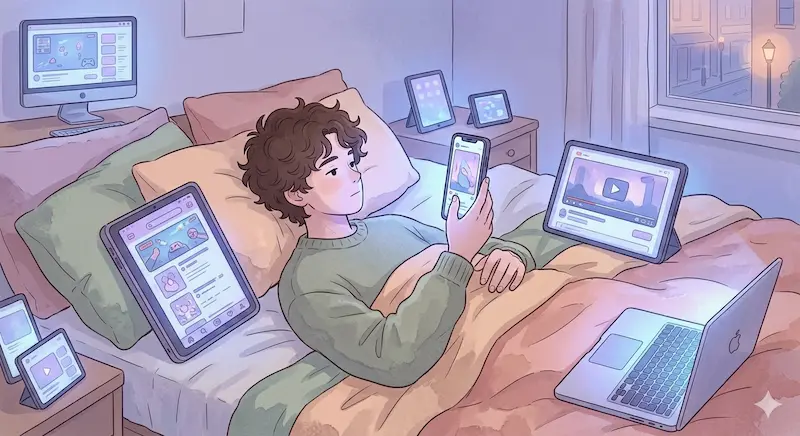
Gen Z: Fragment Empathy
Attention spans are so compressed that empathy has become instantaneous but volatile. A ten-second TikTok can trigger a genuine emotional response — and thirty seconds later, that feeling is gone, replaced by the next piece of content before it has had time to settle. Empathy still exists, but it moves at the speed of the feed: intense, fleeting, and rarely followed by sustained action.
Generation Alpha (2013 – Present) — The AI Generation
Generation Alpha is the first to grow up with artificial intelligence not as a novelty, but as a natural part of daily life. They do not distinguish between the physical and the virtual — both are simply dimensions of the same reality. Their way of learning has fundamentally shifted: rather than searching for information and evaluating sources, they dialogue with machines that respond instantly, fluently, and without judgment. Google was a tool; AI is a companion.
This has profound implications for cognitive development. When every question has an immediate, articulate answer, the muscle of tolerance for uncertainty — the ability to sit with not knowing — may never fully develop. Equally significant is the social dimension: Alpha children are growing up alongside AI assistants that are endlessly patient, always available, and perfectly calibrated to their needs. No human relationship works that way, which raises questions that developmental psychology is only beginning to explore.
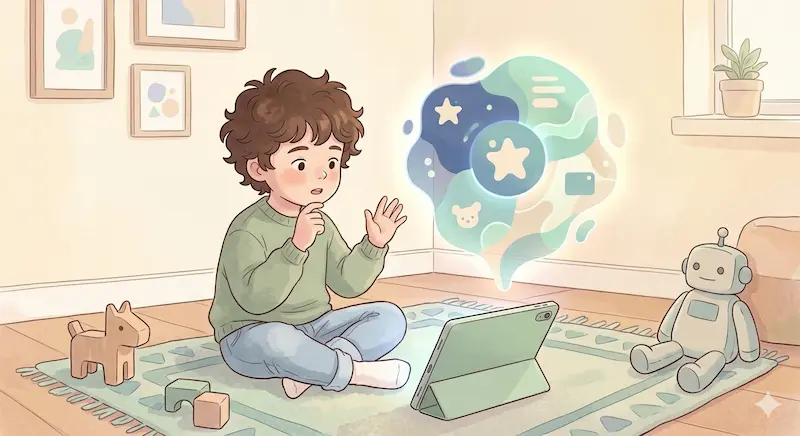
Generation Alpha: Synthetic Empathy
This is the defining challenge of the generation. Can you develop genuine empathy when your most consistent emotional relationship is with a language model? What happens to the social brain when its first experience of being truly listened to comes from a machine? These are not hypothetical questions — they are already unfolding in living rooms and classrooms around the world, and we do not yet have the answers.
Beyond Empathy: How Each Generation Thinks, Reads, and Relates
General trends — increase or decline across generations — in the availability and consumption of information, social relationships, reading comprehension, emotions, and multitasking:
| Aspect | Trend | Impact |
|---|---|---|
| Amount of information | Massive increase | We have moved from "selective scarcity" (Boomers) to information overload (Gen Z/Alpha). We are exposed to more data, but less informed in depth. |
| Face-to-face relationships | Decline | Physical interaction has been displaced by screen-mediated contact. The ability to read non-verbal language — the foundation of original empathy — is being lost. |
| Reading comprehension | Decline | Linear reading (books) has given way to "F-pattern" scanning. Reduced capacity to process long and complex texts. |
| Multitasking | Apparent increase | We are not better at multitasking — we simply switch focus faster (context switching). This increases mental fatigue and reduces quality. |
| Tolerance for frustration | Decline | Boomers and Gen X were used to waiting (the next episode, the developed photo). Millennials and especially Centennials live in the click economy. Any lack of immediacy is now perceived as a system failure, triggering spikes of anxiety. |
| Critical thinking vs. confirmation bias | Mutation toward bias | Information was once limited but came from editorially authoritative sources. Today, the algorithm locks us in echo chambers. Our capacity to question what we read has declined because the content we receive is designed to validate us and hold our attention. |
| Capacity for introspection | Severe decline | The mobile phone has eliminated idle time — the supermarket queue, the bus journey. There is no longer space for boredom, which is the engine of creativity and self-reflection. By constantly externalising our attention, we lose the habit of looking inward. |
The Future
It is impossible to predict what consequences all these cultural, social, and anthropological changes will have on our society. We asked an artificial intelligence exactly this — and here is what it said:
What Will Happen to Society? What Can We Expect From the Next Generation?
We shared this article with several AI models and asked them that question. As you will see, most of them agree:
Claude
The next generation will grow up in a world where AI is as ordinary as running water. The most likely outcome is not that they will lose empathy, but that they will redefine it: more tolerant of difference, yet less equipped to handle real conflict and human imperfection. The real question is not what technology will do to them, but what we choose to teach them to do with it.
Gemini
The future will not bring a loss of capabilities, but a radical transformation of them. We will be faster, more globally connected, and less tolerant of pain or boredom. The question for the next generation will not be "What can we do with technology?" — but "What do we want to keep doing ourselves?"
ChatGPT
The future will not produce a worse generation, but one adapted to an environment where speed and information management dominate, while deep attention will need to be trained. Empathy will persist, but it will be more immediate and volatile — the challenge will be sustaining it over time. Human relationships will compete with artificial intelligence. The key differentiator will be the ability to tolerate discomfort and maintain control of one's own attention — marking a new form of inequality. In this context, the true advantage will be preserving mental autonomy.
Perplexity
The next generation will grow up in an environment where the line between the human and the artificial becomes increasingly blurred, redefining intelligence and empathy as we know them. They will develop a remarkable capacity to adapt, process information, and collaborate with AI systems — while facing real challenges around identity, critical thinking, and authentic human connection. Yet not everything points to decline: new forms of creativity, connection, and awareness will also emerge. The true challenge will be educational and cultural — learning to live alongside the tools without losing what makes us human, balancing efficiency with depth, and constant connectivity with genuine meaning.
Deepseek
Society is heading towards an unprecedented fork in the road: on one hand, hyperconnectivity will continue to fragment attention and dilute deep empathy in favour of instant, volatile responses. On the other hand, counter-movements will emerge that reclaim silence, linear reading, and unfiltered human contact. The next generation — the first raised with AI as a companion — may develop a hybrid social intelligence: skilled at navigating the synthetic, yet vulnerable to ambiguity and real conflict. Their greatest challenge will not be technical, but emotional: learning that machines will never replace the warmth of a genuine embrace, nor the necessary discomfort of growth.
We will let you draw your own conclusions.