
Does Playing Chess Make You Smarter? Science vs. Myth
Is the 64-square board a gym for the mind, or just a complex pastime? In this article we dive into the eternal question of whether chess actually makes us smarter — from last century's theories to the findings of modern neuroscience and the reality of elite competition.
The Intelligence Quotient
The way intelligence is measured has changed dramatically over time. Intelligence tests — the famous IQ tests, with their long, repetitive batteries of geometry, arithmetic, and logical reasoning — have become practically obsolete in professional settings. The problem with these measurements was always the possibility of "cheating": you can improve your score through practice; and even without repeating the exact same test, the brain adjusts to the format, skewing the final result.
These standardised tests measure the Intelligence Quotient, comparing cognitive ability and general intelligence across age groups. IQ was born at the beginning of the 20th century. In 1905, French psychologist Alfred Binet developed the first practical test to identify children with learning difficulties. The term itself was coined by William Stern in 1912. Originally it was calculated with a simple formula: mental age, as obtained in the test, divided by chronological age, multiplied by 100. Today that formula is gone — statistical scales have taken its place.
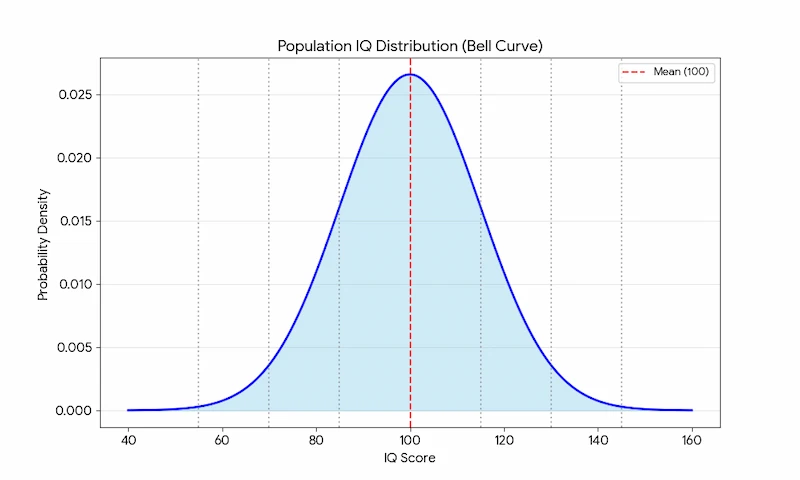
They are still in use, but as a specific tool: for diagnosing disabilities, brain damage, or exceptional ability. In the workplace, IQ is largely out of fashion. It is also widely criticised for failing to capture creativity or artistic talent. External factors such as nutrition, access to education, and environment have an enormous influence on the result.
Intelligence and Chess
Many chess players of intermediate and high level have been interviewed on this, and they all agree: being good at chess does not necessarily make you smarter. The skills required to excel at chess can be almost entirely exclusive to the game itself, with no real bearing on the rest of the player's activities or life. Spatial awareness, memory, and pattern recognition stand out as the core abilities — alongside the drive to improve, the capacity to perform under stress, and the ability to keep your ego in check. None of those qualities are, in and of themselves, either individually or combined, a reliable measure of a person's intelligence.
Psychological Models
Let's pit an older psychological model of intelligence — one that deserves attention for the cleverness with which it is handled and the authority of its author — against a more current psychological paradigm.
The Old Model: Reuben Fine's Freudian Analysis
Chess Grandmaster and psychoanalyst Reuben Fine (1914–1993), in his work The Psychology of the Chess Player (1956), analyses the structure of the game from a Freudian perspective — the King, the Queen, checkmate — as representations of family dynamics and sublimated aggression. He draws on the lives of various chess personalities from his era and earlier.
Chess is the poisoned dart that lodges in the soul, turning it black. — H.G. Wells
The New Model: Fernand Gobet and Cognitive Psychology
Fernand Gobet (born 1962), International Chess Master and Professor of Cognitive Psychology, published The Psychology of Chess in 2018. He goes deep into experimental psychology and cognitive science, exploring how memory, pattern recognition, and training physically affect the brain's structure and decision-making.
Chess and Neuroplasticity: A brief section on what actually happens in the brain. Not just whether you become "smarter", but whether the brain stays "younger" or more flexible — and what that means for the prevention of cognitive decline.
The author argues, backed by well-established research, that an active brain is a young brain — comparing it to a muscle that needs regular training to stay sharp and ward off the cognitive decline that comes with age.
What Gobet calls memory "chunks" are, in practice, tactical patterns and traps that a player recognises instantly, without needing to calculate. That's where the scientific theory connects directly to the chess training.
Emotional Intelligence
As someone who has lived this sport from the inside for years, I'll allow myself to share a more personal perspective on this aspect of chess and intelligence.
I've been an active player for years, and I can say with first-hand knowledge — having competed in tournaments at various levels, spent time in clubs, and both given and received lessons — that the most efficient path to improvement is losing games and analysing them afterwards.
Any player will tell you that chess is a constant exercise in humility. That's why I'd highlight frustration tolerance as the single most critical emotional quality in chess. Without it, you cannot process defeat; and without patience, progress is impossible. Over the years I've come across all kinds of players: those who are ice-cold and utterly unshakeable, and those who let nerves, anger, or even tears get the better of them after a bad decision. In the end, the board puts your character to the test just as much as your mind.
I have learned much more from my defeats than from my victories. — José Raúl Capablanca
Chess is 30–40% psychology. You don't get that when you play against a computer. I can't explain it, but I can't win without it. — Judit Polgar
Chess and Mental Health
There is a whole lineage — and quite a lineage it is — of top-level chess players who have suffered from mental illness of varying degrees of severity. Both authors mentioned above analyse them in depth.
No chess grandmaster is a normal person. The only thing that sets them apart is the severity of their madness. — Viktor Korchnoi
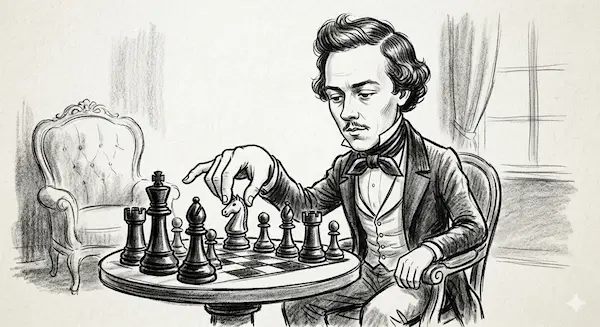
Paul Morphy (1837–1884)
A 19th-century genius, the best player of his era by a crushing margin, who abandoned the game prematurely and retreated into isolation. He was known to hold loud conversations with himself, and was obsessed with the impeccable state of his wardrobe. He retired very early and never stopped expressing his deep hatred of chess. He died at 47 from a cerebral haemorrhage. His brilliant games and moves are still replayed to this day.
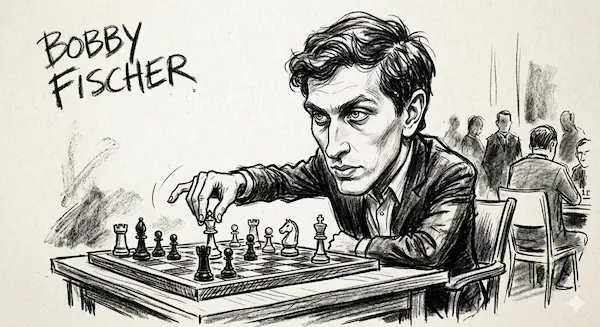
Bobby Fischer (1943–2008)
Considered by some to be the greatest of all time, his match against Spassky — the Russian grandmaster who was world champion at the time — earned him the world title and played out as a chessboard representation of the Cold War. What people remember most vividly are the extreme conditions he demanded in order to play, conditions that had to be met to the letter under the threat of him walking away. His eccentric personality and extreme paranoia defined him throughout his life.
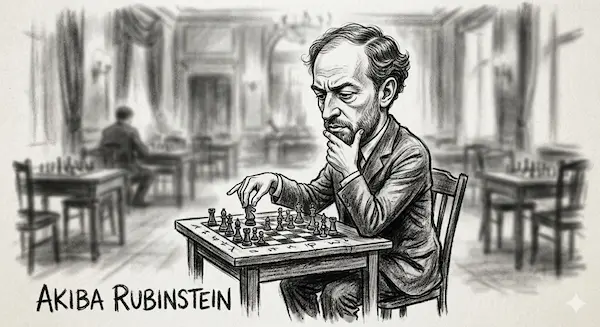
Akiba Rubinstein (1882–1961)
An endgame genius who suffered from such extreme social phobia that, after making his move, he would hide in a corner of the tournament hall until his opponent moved — he simply could not bear the gaze of others. He was the only player of his era to defeat all three of the greatest: Alekhine, Lasker, and Capablanca. He was shy, suffered from nervous spasms, feared crowds, stammered, was even afraid of water… He spent the final years of his life confined to a mental institution.
The New Chess Player
It's worth noting that high-level players have incorporated physical sports — and regular gym sessions — into their training routines. On top of that, many of them subject their bodies to serious physical strain through long tournament days, or even a single exhausting game stretching on for hours.
New technologies have had such a profound impact on the study and practice of the game that the typical chess player has changed. The game of squares is now far more accessible and popular, which means the average player stands out considerably less from practitioners of virtually any other competitive sport.
It would be impossible not to mention how analysis engines like Stockfish and AlphaZero have democratised knowledge and fundamentally changed the way human players think. Chess study rarely goes through books written by teachers who were also great players. Chess books still matter, though they are now more focused on exploring study patterns that go beyond problem-solving, opening theory, or the game itself.
Some believe that the study and memorisation of openings has killed creativity in chess, turning classical chess — where games last considerably longer — into a simple "memory fight": whoever can memorise the most and the best of those endless opening lines carries enough of an advantage to win, with only tiny doses of calculation and imagination required. It is precisely for this reason that alternative formats, such as Chess 960 — created by Fischer himself — are steadily gaining ground.
So, Does Chess Make You Actually Smarter?
Chess does not make you smarter in a general sense — it doesn't raise your IQ, it won't make you better at maths, nor a sharper thinker across the board. The skills it trains are largely specific to the game itself, and chess history is full of "geniuses" whose talent never travelled beyond the 64 squares.
What it does train, and with real intensity, are certain specific capacities: pattern recognition, and the discipline to learn from defeat. Physically, it keeps the brain active and flexible for longer. Emotionally, it toughens you as a competitor and sharpens your ability to face frustration head-on.
Perhaps the greatest gift chess offers is not intelligence, but clarity — as a world champion once put it:
Chess, above all else, teaches you to be objective. — Alexander Alekhine