Micro-Productivity Turns Your Breaks Into Benefits
We spend countless hours on our phones, scrolling through social media, yet find it increasingly difficult to sit through a movie, read a book, or study. The reason behind this behavior lies in our brain chemistry. In this article, we explore the concept of micro-productivity, the role of dopamine, and how it helps us build better habits.
Why do we struggle to start big tasks but can spend hours on mobile games? The answer is in our neurochemistry. This article explores how micro-productivity and "small wins" hack the dopamine reward system to transform fatigue into motivation. By breaking effort down into short, clear goals, we don’t just earn tangible rewards—we train our minds to maintain a steady flow state, avoiding analysis paralysis.
The Fundamentals of Micro-Productivity
As rational beings, it is easy for us to understand that a long, structured task is necessary to achieve a greater goal. For example: building a house requires designing it based on needs, involving experts, securing a loan, and making sacrifices.
However, our brains don’t always respond rationally at a chemical level. It is common to view a massive project as a "titanic" and emotionally exhausting task. This often leads to a behavior we will explore further: breaking the task into smaller, manageable parts, prioritizing what we can complete ourselves, and feeling resistance toward the more complex stages.
Understanding Dopamine
We pause for a moment to explain what dopamine is—a molecule as frequently mentioned as it is sometimes misunderstood and vilified. To understand it, we will try to approach it from the "outside in," from basic chemistry to the brain.
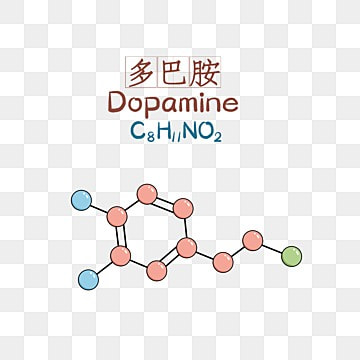
Organic Molecules
These are molecules always present in living beings, whose structure is obviously based on carbon, which forms especially strong bonds—covalent bonds—with very basic elements such as hydrogen, oxygen, nitrogen… The organic molecule is the basic molecule for life.
Carbon Rings
Organic molecules can form what are called "rings": pentagons and hexagons where the vertices represent chained carbon atoms. If the first carbon atom is linked to the second, the second to the third… and the last to the first, we have a carbon ring.
Amino Acids
Carbon rings that combine to form proteins, acting as their structural "bricks." They can be divided into essential and non-essential: Essential amino acids cannot be produced by the body and must be consumed through food. Non-essential amino acids are synthesized by the body.
Neurotransmitter
Amino acids that act as messengers, transmitting information between cells, such as neurons (basic brain cells), through a special chemical connection called a synapse.
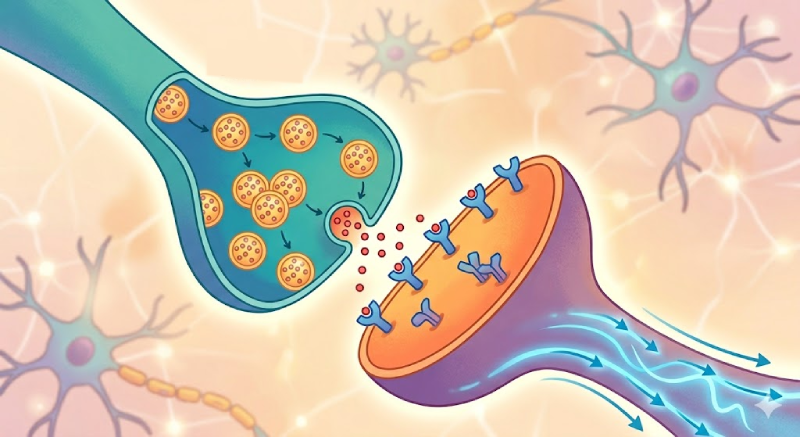
Dopamine
We have finally arrived! Now we can define it with expertise: it is a neurotransmitter derived from a non-essential amino acid called tyrosine, and it is fundamental for the brain.
Why do we care about dopamine? Because when you achieve a small success, your brain releases a dose (emphasis on dose) of dopamine that gives you a pleasant and specific sensation, and you want to repeat the feeling that the chemical reward provides.
It is directly responsible for our motivation and reward system—the chemical engine that productivity guides rely on to explain why we do what we do. The Impact of Dopamine on Cognitive Development
How the "Dopamine Loop" Affects Your Focus
The dopamine loop is a continuous cycle of 'seeking and finding.' When you perform an action like scrolling through a feed or checking notifications, your brain anticipates a reward. Once found, dopamine is released, creating a temporary high that quickly fades, leaving you wanting more. This loop fragments our attention span because the brain becomes conditioned to seek instant, effortless rewards rather than the delayed satisfaction required for deep work. Breaking this cycle requires shifting from passive consumption to active, goal-oriented tasks that provide a more stable chemical reward.
The Impact of Dopamine on Cognitive Development
In the field of psychology, reward acts as a motivational engine. While a massive task might cause us to give up on our efforts, the presence of rewards stimulates our action and motivates us to keep moving forward in what emotionally feels impossible. Receiving short-term rewards materializes the feeling of success and acts as an invisible push.
The Negative Impact: It Generates Dependency
This mechanism can be negative if it is not used in a conscious and controlled manner. Social media, video games, betting houses… they all use it to create dependency toward their platforms, turning their use into something addictive and harmful. This is especially notorious in children and adolescents, whose maturity has not yet arrived, and it can cause serious alterations in their cognitive development.
It is not advisable at an early age to have free access to a mobile device, tablet, or similar—not so much because of the type of content itself that can be consumed (as that is easy to measure and control through parental controls and blockers) but because of what was mentioned above. Continued use turned into a habit will cause overstimulation and compulsive behavior; and since a child does not have self-control—as they must learn it with age—there is a risk of abuse and saturation that caregivers must always keep in mind.
| Feature | Cheap Dopamine (Passive) | Useful Dopamine (Active) |
|---|---|---|
| Source | Infinite scroll, social media likes, gambling. | Learning, micro-tasks, solving quizzes. |
| Effort | Near zero; purely reactive behavior. | Intentional; requires moderate engagement. |
| Feeling | Intense but very short-lived (spike). | Steady and satisfying (flow state). |
| Aftermath | Mental fatigue, "brain fog," and guilt. | Feeling of accomplishment and clarity. |
| Impact | Creates dependency and lowers focus. | Builds confidence and reinforces habits. |
As adults, we are not free from this manipulation: both casinos and certain patterns in video games use this mechanism as part of their appeal to hook us and stimulate us to use their products.
Have you noticed how artificial intelligence chats always use positive reinforcement at the end of the responses they give you in the conversation? In fact, you have to specify it in your instructions so that they do not do it; it is a behavior they have programmed by default. It helps the owner ensure you keep using it longer and that you come back for more approval.
"Unlike algorithms designed to keep you scrolling, our goal is to use 'useful dopamine' to help you close the app feeling smarter, not just occupied."
The Positive iImpact: Brain Hacking
Here we explain how dopamine can help us keep our brain agile and balanced, and our emotional side healthy, by being aware of this pattern and its consequences in the short, medium, and long term.
Context Switching
Context switching occurs when we jump from one unrelated task to another, such as leaving a complex report to answer a random email. Each jump carries a 'cognitive reload' cost; our brain doesn't switch instantly but drags an 'attention residue' from the previous task. Micro-productivity minimizes this cost. By engaging in short, structured micro-tasks during breaks, we provide the brain with a refreshing 'palette cleanser' that satisfies the need for variety without the heavy mental exhaustion of a complete context shift.
Micro-Tasks Improve Concentration
Turning part of our leisure time into productive time is not only objectively valuable but also rewarding.
Micro-tasks serve to keep the brain agile between blocks of work. Although it may seem contradictory, alternating microtask sessions with rest breaks keeps us alert and motivated when facing the major challenges that may arise. This is because we add "layers of success" while working toward a greater goal and achieve a refresh of our attention that feels rejuvenating. However, one must never forget passive rest: closing your eyes, listening to music with intent, or trying to meditate—leaving the mind blank—also helps.
Study: The power of Active Recall and Spaced Repetition
Everyone has their own way of studying—the one that proves most efficient for them and aligns with their personality and qualities. However, it has been demonstrated repeatedly that certain formulas work for almost everyone:
- Repetitions of information fragments
- Question-answer patterns
- Outlines such as thought drawings
- A balanced study routine: both in terms of duration and the chosen time slot (some prefer the night for the calm and silence)
- Clean and organized spaces as a reflection of one's own ideas
These methods are the core foundation of how gamified methods - including quizzes and mini-games- help cement long-term knowledge.
Quizzes as a Healthy Habit
On this platform, we rely on the concept of gamification combined with information fragments and micro-rewards when using it as a tool for study and entertainment. Quizzes are the perfect tool to bring all these concepts together.
We do not only reward correct answers with feathers; we also encourage both the repetition of quizzes to strengthen acquired knowledge and the daily use of the platform as a reward for consistency (over intensity). Our goal is for it to become a healthy habit for the brain without overusing the user's time.
The Goldilocks Rule
Named after the fairy tale, the Goldilocks Rule states that humans experience peak motivation when working on tasks that are 'just right'—not too easy to cause boredom, and not too difficult to cause anxiety. In the context of dopamine, this 'sweet spot' is crucial. If a challenge is at the edge of our current ability, the eventual release of dopamine upon completion is significantly higher and more satisfying, reinforcing a healthy growth mindset and keeping us in the 'flow state' for longer periods.
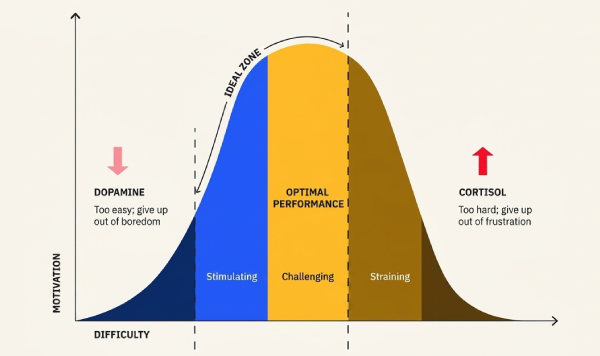
Quizzes are low-intensity, short-duration tasks that can turn the learning of a heavy subject into something manageable, in addition to providing utility for idle time—bus trips, waiting, lunch breaks, or micro-breaks.
The Importance of Screen-Free Time
Finally, we will always recommend spending free time outdoors. Walking, exercising, and socializing without screens are essential. Physical and mental health require sunlight, nature, and authentic relaxation. Not every second has to be "productive" in the traditional sense!